
“Low drawdown” sounds like a simple product feature. In practice, it is a measurement that depends on the data source, calculation method, settings and period being reviewed. Two Gold EAs can display similar percentages while taking very different paths to get there.
Use this page to examine the evidence behind a drawdown claim, compare different risk architectures and decide which questions to answer before selecting an automated XAUUSD system. It is not a safety ranking and does not imply that any product can preserve capital or avoid losses.
Start with the drawdown definition
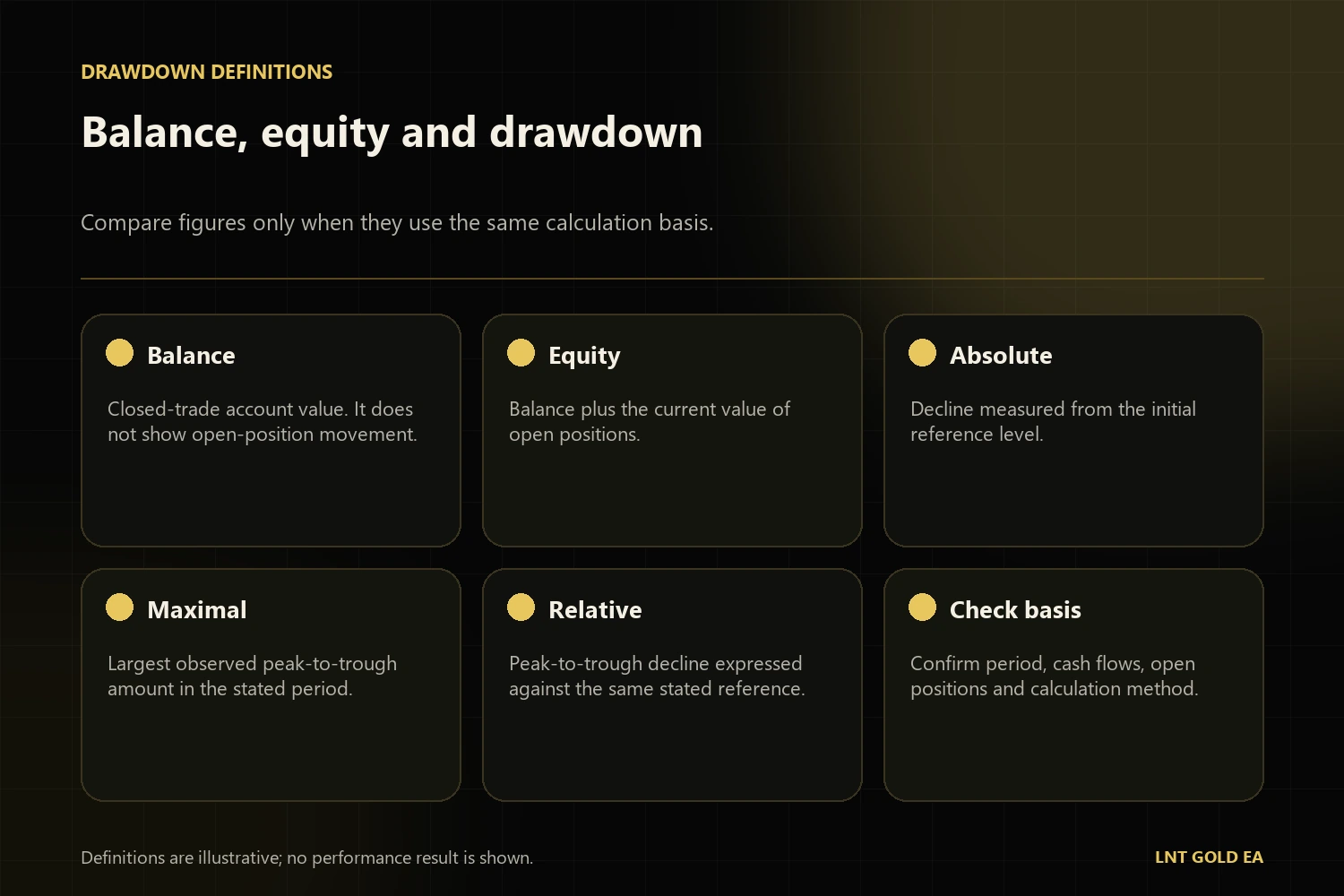
Drawdown measures a decline from a previous peak, but the result changes depending on what is measured.
Balance drawdown
Balance drawdown is based on closed trades reflected in the account balance. It may not show the full effect of open positions at the moment they are under pressure.
Equity drawdown
Equity drawdown includes the changing value of open positions. For strategies that can hold baskets, hedges or recovery positions, equity behavior can provide important context that a balance-only figure may miss.
Absolute, maximal and relative drawdown
Platforms and reports may use different definitions:
- Absolute drawdown compares equity or balance with the initial deposit.
- Maximal drawdown identifies the largest monetary peak-to-trough decline.
- Relative drawdown expresses a peak-to-trough decline as a percentage.
Do not compare percentages until the reports use the same definition.
Separate backtest drawdown from account drawdown
A backtest is a simulation based on historical data and test assumptions. Its drawdown is affected by the test period, tick model, broker data, spread, commission, slippage, product version and SET file.
Account drawdown comes from trading activity on an account, but it still needs context. Check the monitoring source, start date, deposits, withdrawals, product version and whether the data is current. A screenshot or read-only login is useful evidence only when its date and scope are clear.
Review sizing before comparing risk
Position sizing can change drawdown even when the entry logic is unchanged. Ask whether the result used:
- a fixed lot size;
- an automatically calculated lot size;
- a percentage-based risk or margin budget;
- balance-based or equity-based sizing; or
- a preset whose parameters changed during the period.
A profile name such as “Safe” or “Low Risk” is not a measurement. The underlying lot calculation, exposure and exit behavior are what matter.
Compare the strategy architecture
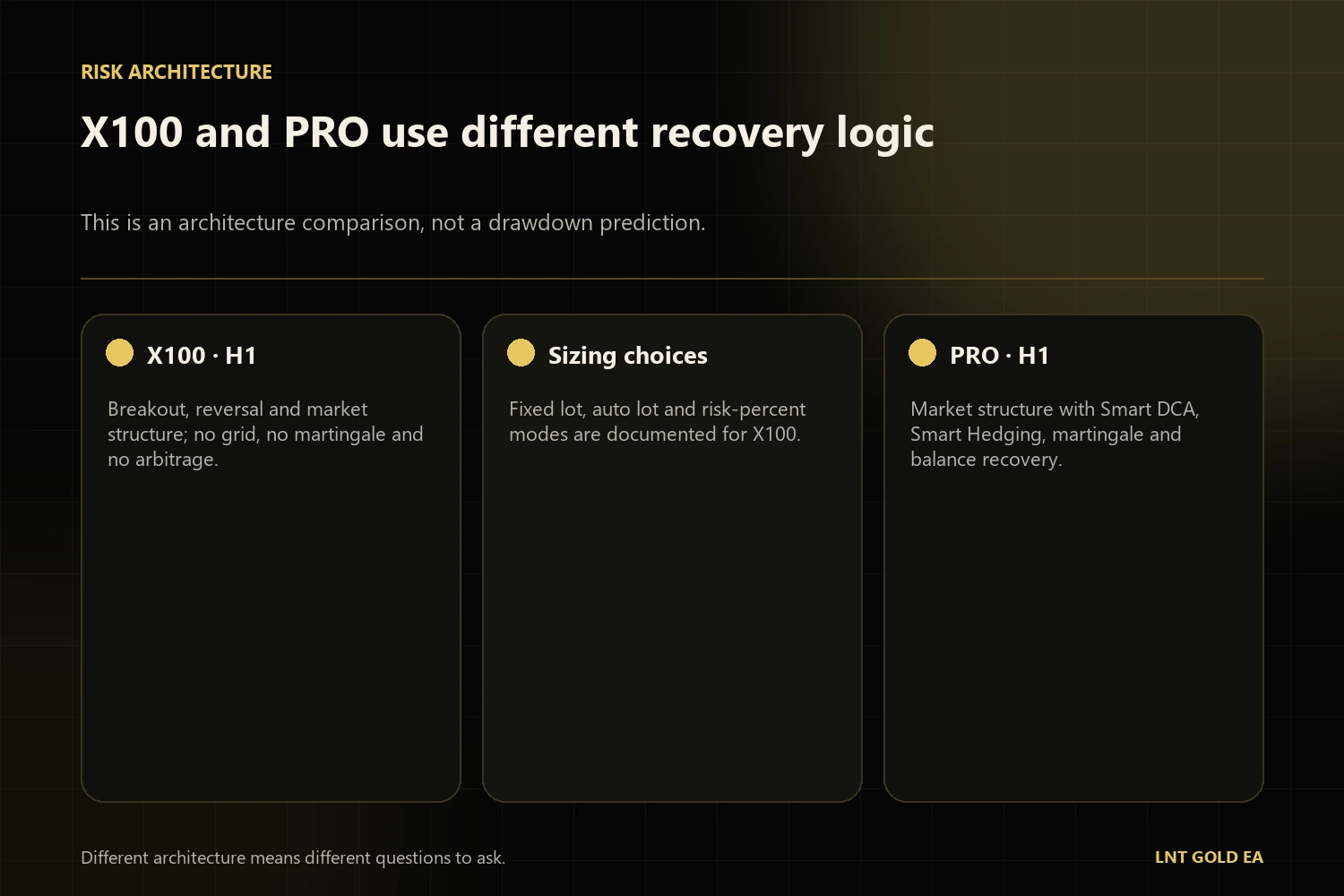
Drawdown is an outcome; architecture helps explain how exposure can develop.
X100: breakout and reversal without grid or martingale
LNT GOLD X100 is presented as an XAUUSD H1 system using breakout, reversal and market-structure logic. The current product page states that it does not use grid, martingale or arbitrage and that it supports Fixed Lot, Auto Lot and Risk % sizing.
This architecture removes grid and martingale recovery from the product design, but it does not remove market risk. A sequence of losing trades, volatile XAUUSD moves, spread expansion, slippage, incorrect sizing or an unsuitable configuration can still create drawdown.
PRO: DCA, hedging, martingale and recovery
LNT GOLD PRO is presented as an XAUUSD H1 recovery system using market detection, Smart DCA, Smart Hedging, martingale and advanced balance-recovery logic. Its BUY and SELL families can be managed independently, and the product page identifies Safe, Medium and High Risk profiles.
Recovery architecture changes the risk questions. Review how a basket grows, when DCA or hedging activates, how exposure is capped, what triggers basket exit, and how balance and equity behave during recovery. The draft does not label PRO safer or riskier than X100; comparable, dated evidence is required before any numerical ranking.
Use an evidence checklist
Before accepting a “low drawdown” description, look for the following:
| Check | Why it matters |
|---|---|
| Drawdown definition | Balance, equity, absolute, maximal and relative figures are not interchangeable |
| Evidence type | Backtest, historical account data and current monitoring answer different questions |
| Start and end dates | A short or selective period may omit difficult conditions |
| Product/version and SET file | Strategy behavior can change across versions and configurations |
| Position sizing | Fixed lot and percentage-based exposure can produce different paths |
| Deposits and withdrawals | Cash flows can distort balance and percentage interpretations |
| Broker and symbol specification | Spread, commission, contract size and execution affect XAUUSD results |
| Full report and update date | A reproducible source is stronger than a cropped screenshot |
| Risk disclosure | Low historical drawdown is not a promise of future loss limits |
Account for XAUUSD operating conditions
Gold can move quickly around news, liquidity changes and market opens. Spread expansion, slippage, gaps and execution latency can alter both entries and exits. A VPS may improve continuity, but it does not eliminate market or broker risk.
Compare evidence using the broker conditions and symbol specification closest to the environment you intend to use. If a report omits those assumptions, treat the comparison as incomplete.
Match the architecture to the decision—not to a safety label
X100 is the direct LNT product fit when the requirement is a breakout/reversal architecture without grid or martingale. PRO is a different fit for users specifically evaluating DCA, hedging, martingale and recovery behavior.
Neither description tells you what drawdown will be in the future. Product selection should combine architecture, sizing, operating requirements, current evidence and personal risk tolerance.
Review LNT GOLD X100 when evaluating a no-grid/no-martingale architecture, and compare LNT GOLD PRO separately when evaluating DCA, hedging, martingale and basket-recovery behavior. Use the current product pages for license and support information.
Frequently asked questions
What is a low drawdown Gold EA?
It is a search description, not a standardized category. A meaningful evaluation must identify the drawdown definition, evidence source, period, settings and operating assumptions.
Is equity drawdown more useful than balance drawdown?
They answer different questions. Equity drawdown includes open-position fluctuation and can reveal pressure not yet recorded in the closed-trade balance. Review both when available.
Does no martingale mean low drawdown?
No. Removing martingale changes the architecture, but drawdown can still arise from losing trades, volatility, sizing and execution conditions.
Can a backtest prove future drawdown?
No. It shows simulated behavior under historical data and specified assumptions. Live conditions can differ.
Is X100 safer than PRO?
This draft does not make that claim. X100 and PRO use different architectures. A safety or numerical risk ranking would require comparable settings, periods, drawdown definitions and evidence.
What should I verify before using an EA?
Verify the product version, SET file, sizing, broker conditions, evidence date, drawdown definition, risk disclosure and whether the monitoring source is current.
Risk disclosure
Trading Forex, CFDs and precious metals involves significant risk. Automated systems can lose money. Historical drawdown, backtests and account monitoring do not guarantee future results or a maximum loss.