
The best EA for XAUUSD depends on more than whether it trades Gold. Timeframe, entry logic, spread sensitivity, position sizing and recovery behavior can create very different operating and risk profiles.
SPEED is an adaptive breakout system for XAUUSD M15. X100 uses breakout, reversal and market-structure logic on H1 without grid or martingale. PRO uses H1 market-structure detection with DCA, hedging, martingale and balance recovery. This comparison focuses on the XAUUSD-specific differences that affect setup, execution and risk.
XAUUSD-specific comparison
| XAUUSD decision factor | SPEED | X100 | PRO |
|---|---|---|---|
| Timeframe | M15 | H1 | H1 |
| Entry/strategy focus | Adaptive breakout, swing/fractal levels and pending entries | Breakout, reversal and market structure | Market detection and recovery management |
| Execution sensitivity to inspect | Spread expansion, pending-order handling, latency and symbol specification | H1 structure, stop/trailing behavior, spread and sizing | Basket exposure, hedge execution, swaps, margin and recovery duration |
| Position sizing described | Fixed Lot; balance/equity margin-budget modes | Fixed Lot; Auto Lot; Risk % | Safe, Medium and High Risk profiles; verify the active SET file |
| Grid/martingale | Review current documentation and the active SET file | No grid; no martingale | Martingale is used as part of recovery |
| Hedging/recovery | Review current documentation and the active SET file | Not presented as core logic | Smart Hedging, Smart DCA and balance recovery |
| Evidence route | Product backtest and monitoring sections | Product evidence and risk sections | Product evidence and recovery-risk sections |
| Primary fit question | Can the environment support M15 adaptive breakout execution? | Does the buyer want H1 logic without grid/martingale? | Does the buyer understand recovery and basket-level risk? |
M15 versus H1 is an operating choice
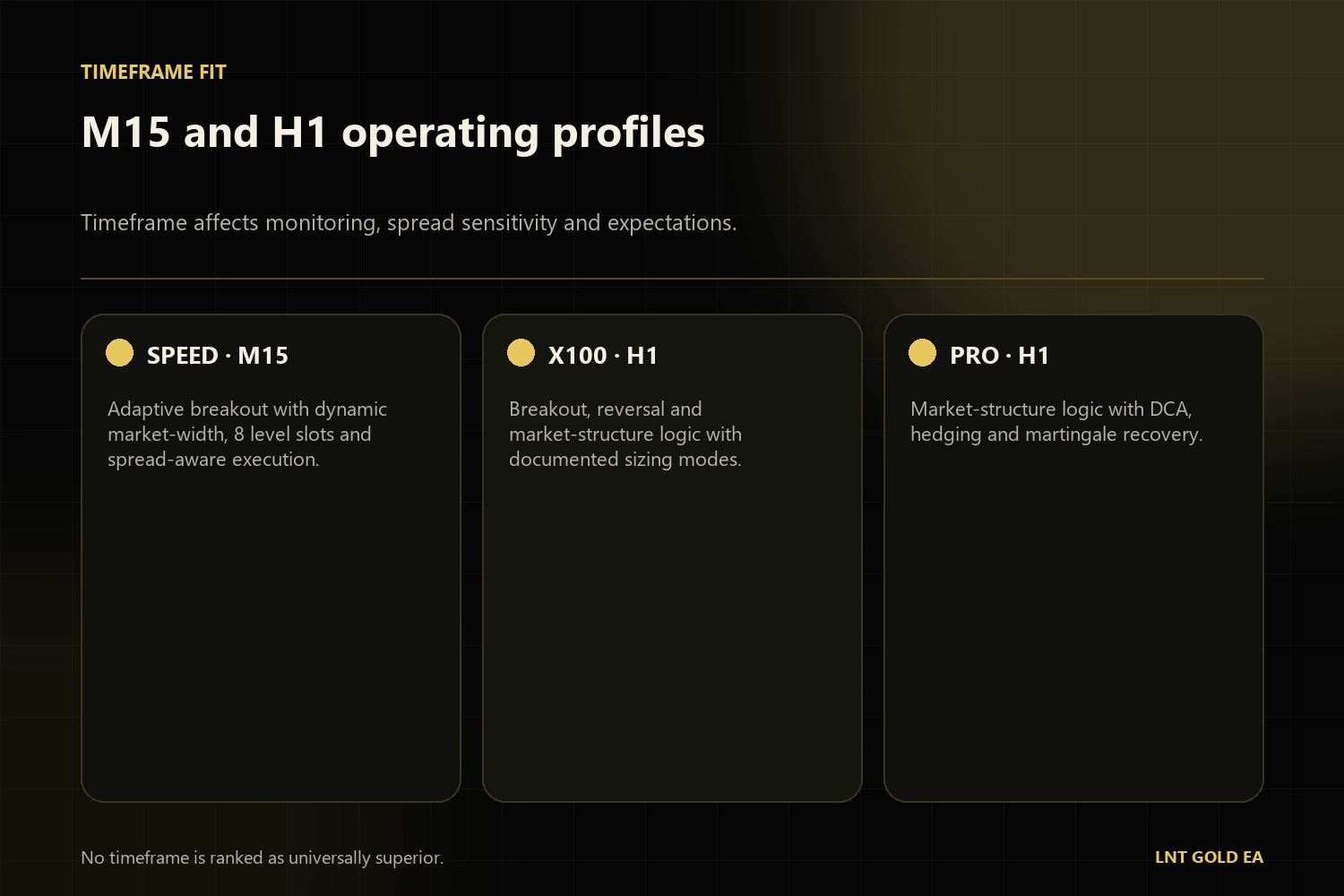
SPEED on M15
M15 creates more frequent chart updates than H1 and makes spread-aware entry handling especially relevant. SPEED documents dynamic market width, eight independent level slots and filters that can pause entries during abnormal spread expansion. The buyer should confirm the intended symbol specification, SET file, VPS and sizing mode.
X100 and PRO on H1
X100 and PRO are both documented for H1, but their logic is materially different. X100 follows breakout/reversal and market-structure conditions without grid or martingale. PRO manages positions through DCA, hedging, martingale and basket recovery. Sharing a timeframe does not make their risk behavior equivalent.
Compare execution assumptions
Before selecting any XAUUSD robot, confirm:
- the exact broker symbol and contract size;
- typical and stressed spreads;
- commission, swaps and slippage;
- minimum stop distance and order restrictions;
- VPS latency and terminal availability;
- whether pending orders or market orders are used;
- the sizing mode and maximum intended exposure;
- how open positions are handled through volatility and market gaps.
These fields should appear beside evidence, not only in installation notes.
Risk-model comparison

No grid or martingale does not mean no risk
X100's documented exclusions are useful selection information. They do not eliminate losses from a false breakout, reversal failure, oversized risk percentage, slippage or prolonged volatility.
Recovery logic requires basket-level analysis
PRO's DCA, hedging and martingale features must be assessed at the basket level. Review cumulative position size, margin use, swaps, hedge behavior and the conditions under which the basket can remain open or be closed at a loss.
Unverified fields should stay unverified
The reviewed SPEED source does not clearly establish its grid, martingale, hedging or recovery status. Do not infer the answer from its breakout label. Obtain approved product documentation before adding those cells to production copy.
Backtest and live evidence
A valid XAUUSD comparison needs consistent evidence fields across products. At minimum, show product version, settings, period, broker/data source, spread/cost assumptions, starting balance, sizing method, net result, maximum equity drawdown and limitations. For live evidence, add account type, deposits/withdrawals, open exposure and update date.
Use each product's current evidence and risk sections, and verify every destination before publication. Do not rank products using incomparable screenshots, settings or test periods.
How to choose
- Choose the SPEED review path if the main question is adaptive M15 breakout execution and spread-aware level management.
- Choose the X100 review path if the main question is H1 breakout/reversal logic with explicit no-grid/no-martingale design.
- Choose the PRO review path only if the main question includes DCA, hedging, martingale and basket recovery and those risks are acceptable and understood.
- Return to the buy XAUUSD EA page when the comparison is complete and the remaining questions are license, requirements and purchase process.
This is a product-fit framework, not a performance ranking.
Risk disclosure
XAUUSD can be volatile, and broker conditions can materially affect automated execution. All three products can lose money. Backtests and live-account observations are historical evidence, not future promises. Users are responsible for configuration, capital allocation, platform uptime and risk monitoring.
Frequently asked questions
What is the best XAUUSD EA for MT5?
The answer depends on strategy and risk fit. Compare timeframe, execution assumptions, position sizing, recovery mechanics, evidence quality and license scope instead of relying on a universal “best” claim.
Which LNT XAUUSD EA runs on M15?
SPEED is documented for M15. X100 and PRO are documented for H1.
Which product avoids grid and martingale?
X100 is documented as using neither grid nor martingale. That is one comparison field, not a guarantee of low drawdown or profit.
Which product uses hedging and DCA?
PRO is documented as using Smart Hedging and Smart DCA within its recovery architecture.
Can I compare backtest returns directly?
Only when the test periods, data, costs, settings, versions and sizing are comparable. Otherwise, the headline returns do not support a fair ranking.